Mathematician · Research Fellow

Aluna
Rizzoli

I study algebraic groups through the way they act — in the geometry group at King’s College London. Increasingly, I put frontier AI to work on the mathematics itself.

  • loc London, UK
  • field Algebraic groups · Representation theory
  • now AI-powered mathematics
  • since 2024 · King’s College London
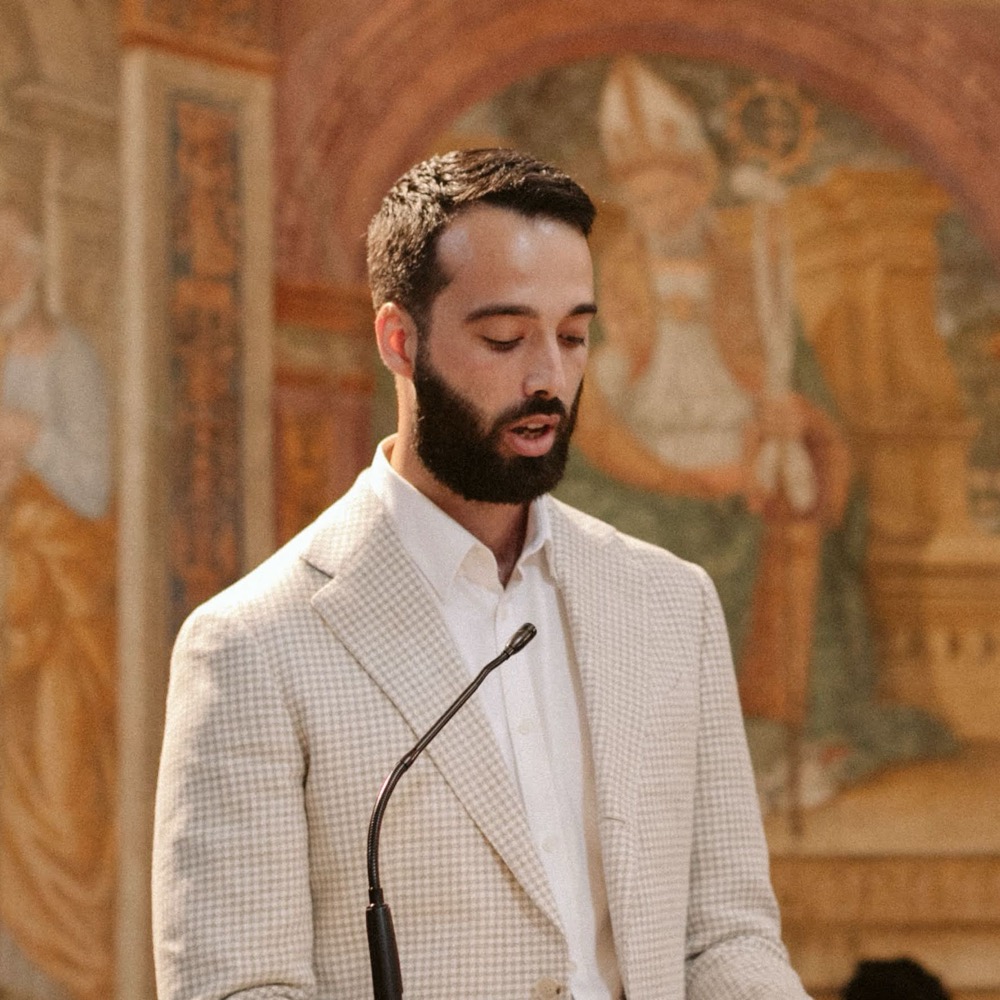
Aluna Rizzoli speaking at a lectern in front of a Renaissance fresco.

01 / about

A mathematician who codes the abstract into the concrete.

I am a Postdoctoral Fellow in the geometry group at King’s College London, working on algebraic groups, rational actions, and representation theory.

I completed my PhD at Imperial College London under Martin Liebeck, followed by a year as an INI–Simons Postdoctoral Fellow at the University of Cambridge and two years as an SNSF-funded Research Scientist at EPFL.

// experience & education

  1. 2024–Research FellowKing’s College London — geometry group
  2. 2022–24Research Scientist (SNSF)EPFL — Testerman group
  3. 2021–22INI–Simons Postdoctoral FellowUniversity of Cambridge
  4. 2017–21PhD in MathematicsImperial College London — “A double coset problem for classical groups”, adv. Martin Liebeck
  5. 2013–17MMath, 97.0% · Miller PrizeUniversity of St Andrews

Selected talks at Imperial, Manchester, Warwick, Cambridge, EPFL, Banff, and others. Awards include the EPSRC Studentship, Miller Prize, Sanderson Prize, and the Arthur Hinton Read Memorial Prize.

02 / research

Algebraic groups, studied through their actions.

I study algebraic groups indirectly — through the way they act on other objects, and what their orbit structures reveal. A lot of my work is computational: I write Magma code to understand the actions of matrix groups over finite fields, then connect the results back to the infinite case.

My recent work classifies the generic stabilizers for simple algebraic groups acting on orthogonal and symplectic Grassmannians, and explores multiplicity-free representations and modules with finitely many orbits.

That computational bent has grown into a second thread: mathematics × AI.

  • Algebraic groups
  • Representation theory
  • Rational actions
  • Generic stabilizers
  • Grassmannians

03 / mathematics × ai

Computational group theory and AI, hand in hand.

Frontier models can now write serious mathematical code, drive searches through enormous spaces, and attempt research-level proofs. I use them as instruments on hard problems in group theory — and help measure what they can really do. The two threads fit together beautifully.

// flagship · 2026 · with Codex in the loop

Finding 59:29 in the Monster

H. Dietrich, M. Lee, A. Pisani, A. Rizzoli

The Monster — the largest sporadic finite simple group — had explicit generators available for every class of maximal subgroup except one: 59:29. We constructed its generators through a fingerprint search that examined 286 million candidates, built and run with OpenAI’s Codex as a genuine collaborator in the mathematics. The construction also yields a short new proof that the Monster has no subgroup PSL₂(59), correcting a 2004 result.

// benchmark · 2025

IMProofBench

J. Schmitt et al. — 60+ mathematicians, incl. A. Rizzoli

A peer-reviewed benchmark of 77 research-level proof problems written by expert mathematicians, used to evaluate frontier models in an agentic setting — with tools like SageMath and web search in hand.

// next

More AI-powered mathematics in the works — watch this space.

04 / publications

Selected publications

9 papers · 2017–2026

  1. 2026

    Finding 59:29 in the Monster ai

    H. Dietrich, M. Lee, A. Pisani, A. Rizzoli

    arXiv preprint — math.GR

  2. Draft

    On the inverse problem for isometry groups of finite-dimensional norms

    E. Breuillard, M. Liebeck, A. Naor, A. Rizzoli

    In preparation — a proof of a 40-year-old open problem.

  3. 2025

    IMProofBench: Benchmarking AI on research-level mathematical proof generation ai

    J. Schmitt et al. — 60+ co-authors, incl. A. Rizzoli

    arXiv preprint — cs.CL

  4. 2025

    Multiplicity-free representations of the principal A₁-subgroup in a simple algebraic group

    A. Rizzoli, D. Testerman

    Pacific Journal of Mathematics — vol. 336

  5. 2025

    Generic stabilizers for simple algebraic groups acting on orthogonal and symplectic Grassmannians

    A. Rizzoli

    Forum of Mathematics, Sigma — vol. 13

  6. 2022

    Modules for algebraic groups with finitely many orbits on totally singular 2-spaces

    A. Rizzoli

    Journal of Algebra — vol. 606

  7. 2021

    Finite singular orbit modules for algebraic groups

    A. Rizzoli

    Journal of Algebra — vol. 570

  8. 2018

    On the average box dimensions of graphs of typical continuous functions

    B. Adam-Day, C. Ashcroft, L. Olsen, N. Pinzani, A. Rizzoli, J. Rowe

    Acta Mathematica Hungarica — vol. 156

  9. 2017

    Interactive simulations for quantum key distribution

    A. Kohnle, A. Rizzoli

    European Journal of Physics — vol. 38, no. 3

05 / side projects

Data science & machine learning, for fun

Written up on Medium

06 / beyond the math

Off the page

When I’m not chasing orbits, I play chess, explore London’s theatre scene, and keep up an ongoing (and stubbornly difficult) sourdough journey.

  • Chess
  • Theatre
  • Sourdough

07 / contact

Get in touch.

aluna.rizzoli@kcl.ac.uk
Department of Mathematics
King’s College London
Strand, London WC2R 2LS
United Kingdom